


Industrial automation has been changing manufacturing for decades. Programmable controllers, robotic assembly, CNC machining — each wave took specific tasks and made them faster, more consistent, or more scalable with machines.

AI in industrial automation follows the same pattern, but addresses a different category of problems. Traditional automation is deterministic: it executes a fixed programme every time, in every situation. That works when the task is well-defined and conditions are predictable. It breaks down when conditions vary or when the right action depends on context. That's what AI adds: the ability to handle variation, learn from data, and adapt to conditions rather than assuming they're constant.
In practice, AI in industrial automation is most valuable where static rules are no longer enough — where inspection, maintenance, scheduling, or control decisions depend on changing conditions rather than fixed inputs.
What Counts as AI in Industrial Automation
In current industrial deployments, the techniques being applied are machine learning models trained on operational data, computer vision systems that interpret images or video, anomaly detection algorithms that flag unusual sensor patterns, and reinforcement learning systems that optimise control parameters over time.
This is distinct from generative AI, which has a narrower role in manufacturing operations. The technology changing industrial automation is primarily about pattern recognition, prediction, and adaptive control — applied to specific operational problems with defined inputs and measurable outcomes.
That is also what separates this topic from broader AI in manufacturing, which includes planning, forecasting, and decision support across the business as well as more execution-level use cases on the shop floor.
Use Cases Across Quality, Maintenance, Inspection, and Operations
Visual quality inspection
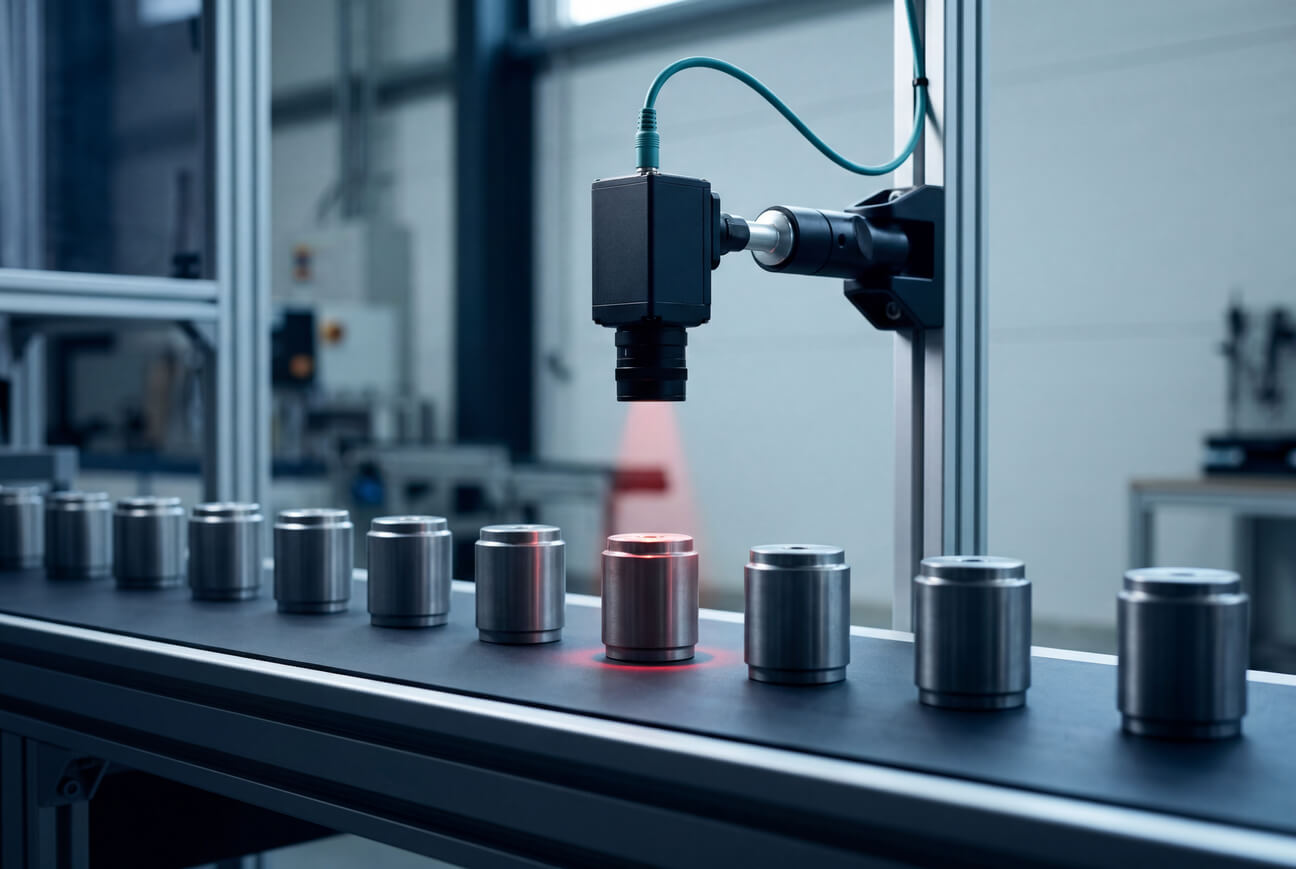
Camera-based inspection systems powered by computer vision inspect at line speed with consistent sensitivity — 100% coverage, continuously, without fatigue. The more advanced implementations don't just classify pass/fail: they categorise defect types, track rates by production parameter, and feed data back into process control so systematic defects trigger adjustments rather than just rejections.
Predictive maintenance
AI for manufacturing equipment uses continuous sensor data — vibration signatures, temperature profiles, current draw patterns — to detect early degradation before it becomes failure. Maintenance happens when data indicates it's needed, not on a conservative fixed schedule. For manufacturers with high-value or high-utilisation equipment, the return on sensor infrastructure and model development is typically favourable within the first year.
Adaptive process control
Machine learning in manufacturing process contexts learns which parameter combinations produce the best results under which conditions — raw material variation, ambient shifts, equipment drift — and adjusts control parameters in real time. In processes where optimal settings depend on continuously varying inputs, adaptive control improves yield measurably.
Production scheduling in high-mix environments
Scheduling systems that learn from historical production data — actual cycle times by job type, setup time by transition, machine performance profiles — can generate schedules that outperform expert planners on throughput and on-time delivery, and re-optimise when disruptions occur. The advantage is most pronounced in high-mix environments where daily scheduling decisions exceed what planners can manually evaluate.
The common thread across these use cases is not “automation with AI” in the abstract. It is applying models where variability, speed, or pattern complexity make conventional automation too rigid or too limited.
Data and Integration Requirements
Every use case above shares one prerequisite: reliable, continuous, accessible data. Sensor infrastructure investment is often the largest line item in an industrial AI project — machines not instrumented when installed, sensors not connected to a data historian, networks that don't support the required bandwidth.
Closing the loop matters too. AI systems that only produce outputs for human review deliver less value than systems where model outputs drive actions: quality inspection that routes defective product automatically, predictive maintenance that creates a work order in the CMMS, adaptive control that adjusts setpoints in the DCS. Those integrations require coordination with MES, CMMS, SCADA — achievable, but requiring careful validation before automation is enabled in production.
In many environments, those dependencies expose deeper data integration problems across operational systems rather than a simple lack of AI readiness.
Build vs. Buy Decisions
Purpose-built platforms provide pre-built connectors to common industrial systems and model templates for common use cases. Less flexibility, but faster time to value for well-defined problems like predictive maintenance or quality inspection.
Custom development provides maximum flexibility at higher cost and is most justified when the use case is genuinely novel or when operational context requires customisation that platforms can't accommodate. For most first industrial AI deployments, starting with a platform for a well-defined use case produces results faster than building from scratch.
The right decision usually depends less on whether AI is strategically important and more on how unusual the process, data environment, and integration requirements really are.
What Makes an Industrial AI Use Case Viable
- Reliable, continuous sensor data on the equipment or process — not sampled or manually collected
- A specific operational metric to improve, not 'use AI' but 'reduce unplanned downtime by X%'
- A process owner accountable for the outcome, not just a technology sponsor
- Capacity to validate model outputs against operational reality before live deployment
- Integration pathway to the production systems that need to act on model outputs
For most manufacturers, that evaluation works best when it sits inside a broader digital transformation roadmap for manufacturing, rather than being treated as a standalone innovation decision.
At xfive, we build the data pipelines and custom integrations that connect AI outputs to manufacturing execution systems — making industrial AI results actionable within production, not just visible in a dashboard. → xfive.co/industries/manufacturing-software-development
FAQ
What is AI in industrial automation?
The use of machine learning, computer vision, and related techniques to enable automation systems to handle variation and learn from data. Current applications include visual quality inspection, predictive maintenance, adaptive process control, and production scheduling optimisation. The AI works on specific problems with defined inputs and measurable outcomes, not as a general-purpose capability.
How is AI different from traditional industrial automation?
Traditional automation is deterministic — it executes a fixed programme given consistent input. AI for manufacturing operations handles conditions that vary and decisions that depend on context. The two are complementary: most industrial AI applications work alongside traditional automation rather than replacing it.
Where should a manufacturer start with machine learning in manufacturing?
With a specific operational problem and an honest assessment of data prerequisites: reliable, continuous sensor coverage, accessible format, and a measurable outcome to improve. Scope a bounded proof-of-concept on that specific problem before committing to broader deployment.
About the author