


Digital transformation in manufacturing is the process of replacing disconnected systems, manual workflows, and outdated reporting with connected digital infrastructure that improves visibility, coordination, and decision-making across the business.
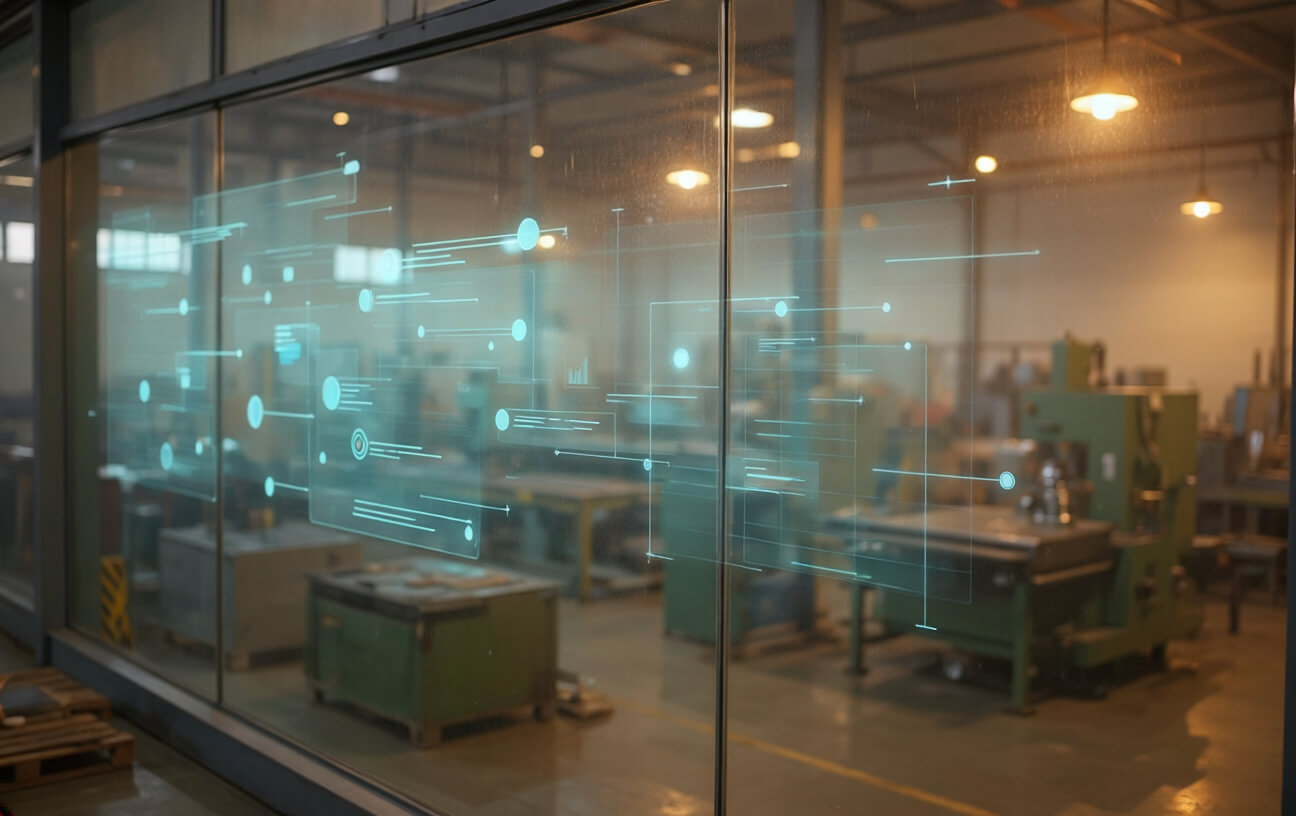

In practice, manufacturing digital transformation is not about adding software for its own sake. It means connecting ERP, MES, CRM, portals, and reporting tools so sales, operations, service, and leadership can work from the same operational reality.
This isn't about adopting technology for its own sake. The transformation part happens when connected systems change how decisions get made — not just where data is stored.
Why Manufacturers Struggle to Modernise
Most manufacturers share a recognisable set of frustrations. ERP and MES don't talk to each other. Sales reps quote delivery times based on gut feel because production data lives somewhere nobody can access quickly. Customer portals show information that's three days old. Quality issues surface after the fact.
These aren't individual system failures. They're symptoms of a fragmented architecture — where each system does its job in isolation, and humans bridge the gaps manually. Digital transformation in manufacturing industry contexts is, at its core, the work of closing those gaps.
Core Systems Involved in Manufacturing Digital Transformation
ERP — the centre of gravity
Almost every digital transformation for manufacturing runs through the ERP. It holds financials, procurement, inventory, and order management. It's also usually the oldest system in the stack — embedded deeply, hard to change, but often the key to unlocking everything else.
MES — the shop floor link
The MES sits between the ERP and physical production. When ERP and MES are properly connected, production data flows into planning in real time instead of arriving the next morning in a spreadsheet. That single integration changes the quality of every scheduling and capacity decision downstream.
CRM — where sales meets operations
In most manufacturers, CRM and ERP live in separate worlds. Sales reps don't have visibility into real order status. Customer service answers complaints with information that doesn't match what operations knows. Well-scoped CRM ERP integration is one of the highest-value changes a manufacturer can make commercially.
In most manufacturing environments, digital transformation usually involves:
- connecting ERP and MES data,
- improving CRM visibility into operational status,
- replacing spreadsheet-based handoffs,
- building customer or dealer self-service tools,
- creating cleaner reporting and analytics flows.
Customer-facing digital tools
Once core systems are connected, it becomes possible to build the tools that buyers increasingly expect: filterable product catalogs, self-service dealer portals, order tracking that reflects actual production status. These aren't marketing investments — they're commercial infrastructure built on top of the operational foundation, and they also create the conditions needed for more advanced capabilities such as analytics and AI in manufacturing.
Common Use Cases and Examples
What is digital transformation in manufacturing when it shows up in practice? A dealer portal that eliminates email-based updates and keeps partner data accurate across hundreds of contacts. A product catalog that engineers can filter by technical parameter in seconds instead of hunting through PDFs. A sales workflow where reps see real-time inventory and delivery timelines without calling operations.
Each of these solves a specific, measurable problem. That's the pattern: transformation projects that start with a defined friction point consistently outperform those that try to modernise everything at once.
Risks, Blockers, and Legacy Constraints
The failure modes are predictable. Projects scoped too broadly, integration complexity that was underestimated, data quality problems that nobody addressed before migration, change management treated as a communication exercise rather than a real organisational challenge.
Legacy systems add a specific constraint: the ERP that's been running for fifteen years wasn't designed to share data. Getting value from manufacturing digital transformation often requires building an integration layer around existing systems rather than replacing them outright - especially where long-standing data integration problems are limiting visibility across the business.
What Successful Digital Transformation in Manufacturing Usually Looks Like?
Successful digital transformation in manufacturing rarely looks like a full-system replacement delivered in one go. More often, it looks like a series of connected improvements that remove friction from critical workflows.
ERP, MES, CRM, and customer-facing tools do not need to be replaced at the same time — but they do need to exchange the right data reliably. Sales teams gain visibility into order status and delivery timelines. Operations teams stop relying on spreadsheets and manual updates. Customers and partners get more accurate information through portals, product tools, and service workflows.
The common pattern is not “more technology.” It is better coordination between existing systems, cleaner data flows, and clearer ownership of the processes that matter most. That is what makes manufacturing digital transformation successful in practice.
Where to Start
The best starting point is not a platform decision. It is understanding where the business is losing time, visibility, or margin because systems do not work well together.
In most manufacturing environments, that means looking closely at a few practical questions first:
- Where are teams still relying on spreadsheets, email handoffs, or manual data entry?
- Which decisions are being made with delayed or incomplete operational data?
- Where do customers, partners, or sales teams feel the effects of disconnected systems most clearly?
- Which integration or data quality issue is creating the most friction across the business?
The answers usually make the first priorities obvious. Instead of trying to modernise everything at once, manufacturers can focus on the systems and workflows where better visibility or cleaner data flow will have the greatest immediate impact. From there, those priorities can be shaped into a practical digital transformation roadmap for manufacturing that sequences change in a way the business can absorb.
At xfive, we work with manufacturers on the full arc of digital transformation: legacy system modernisation, secure system integrations, and bespoke platform development. If you're working out where to start, that's a conversation worth having. → xfive.co/industries/manufacturing-software-development
FAQ
What is digital transformation in manufacturing, in plain terms?
It's the process of connecting the systems that currently operate in silos — ERP, MES, CRM, customer-facing tools — so that data flows between them reliably and the business can make faster, better-informed decisions. The technology is the means; the change in how the business operates is the point.
How long does manufacturing digital transformation take?
A well-scoped Phase 1 can deliver results within six to twelve months. Full transformation of core systems typically takes two to four years when managed as a series of phased projects.
Build custom software or implement a commercial platform?
Usually both. Platforms handle common workflows efficiently. Custom software is most justified for the integration layer between those platforms and for customer-facing tools that need to reflect your specific product range.
About the author