


In this article, I'll show you how you can design your own Quality Assurance Scoring System based on the criteria from my previous article, Code Quality Assurance Checklist: 8/20 Rule.
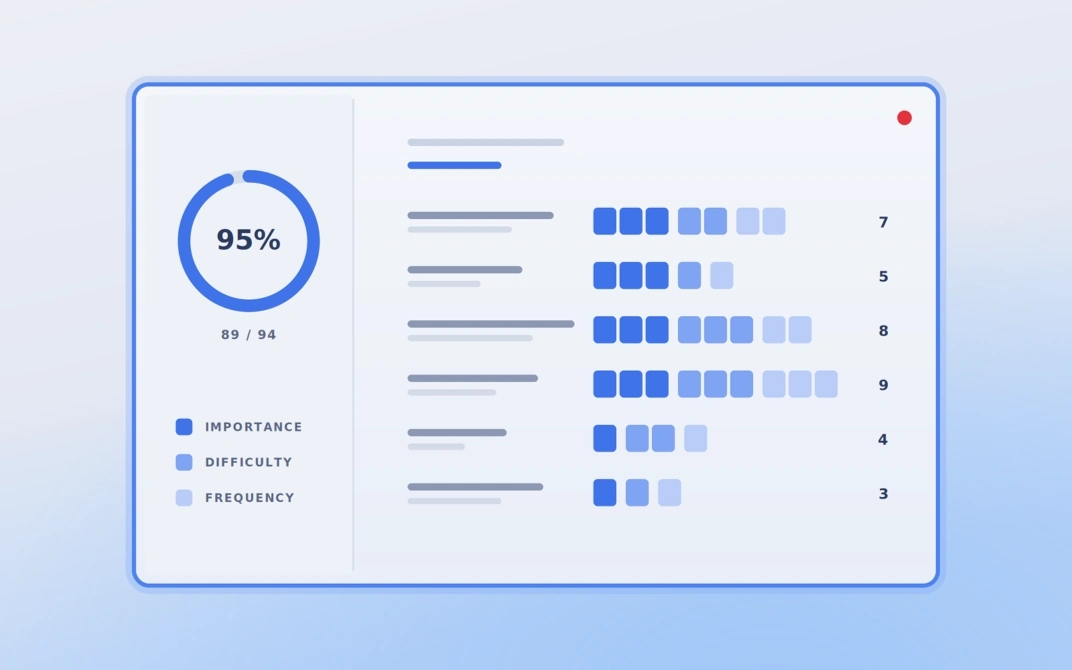

For each criterion on our list, we set the maximum number of points a developer can get. This maximum represents the criterion's weight and is based on:
- How important the criterion is for the project's success: Very important – 3 points, Important – 2 points, Less important – 1 point
- How difficult it is to fulfill: Challenging – 3 points, Intermediate – 2 points, Easy – 1 point
- How often it causes problems in your projects: Frequently – 3 points, Occasionally – 2 points, Rarely – 1 point.
Maximum points represent the criterion's weight.
For example, it's very important for any design to website project that the pages work without JavaScript errors (3 points). On the other hand, it's easy to fulfill (1 point), and let's assume it rarely causes problems in your projects (1 point). In that case, a developer can get a maximum of 5 points for meeting this criterion.
If JavaScript errors are found during QA, the developer gets fewer points, e.g., 3 points, depending on the number of errors.
The maximum points we use at xfive for each criterion are listed below:
- Are all required pages / states developed? – 5 points
- Are all requirements met? – 7 points
- Do pages work without JavaScript errors? – 5 points
- Is reasonable pixel precision achieved? – 8 points
- Do pages display and work correctly in supported browsers? – 9 points
- Are all pages valid? – 5 points
- Are the correct tags being used? – 6 points
- Are the pages using microformats where appropriate? – 4 points
- Do pages follow agreed HTML coding standards? – 4 points
- Do pages follow agreed CSS coding standards? – 4 points
- Do pages follow agreed JavaScript coding standards? – 4 points
- Are stylesheets merged? – 3 points
- Are image files sufficiently compressed? – 3 points
- Are CSS sprites being used for images? – 4 points
- Is usage of excessively specific CSS selectors and improper use of the !important rule avoided? – 4 points
- Can page content be understood and easily navigated with images turned off? – 5 points
- Do pages degrade gracefully with JavaScript turned off? – 4 points
- Are correct ALT attributes for images provided? – 4 points
- Is the proper heading structure in place? – 3 points
- Are labels associated with FORM elements? – 3 points
The QA Score is then calculated as a percentage:
QA Score = Acquired points / Total max points × 100
In our case, the total maximum a developer can get is 94 points. If a developer gets 89 points, their score is 95% (89 / 94 × 100).
If a criterion is not applicable, for example when a site has no use for microformats, its points are subtracted from the total max points, and the score is calculated only from the points a developer can actually get.
The system can be adapted to various needs, and a user-friendly tool can be built for Quality Controllers to rate each criterion. Another advantage is that by changing the criteria weights, you can put more focus on the areas that cause problems most often in your software development life cycle (SDLC).
Series Contents
- Code Quality Assurance Checklist: 8/20 Rule
- Can Front-End Code Quality Be Measured?
- Using QA in Front-End Developer Recruitment
About the author