


In this article, concluding the series about Quality Assurance on design to website projects, I'll show you how to use QA in front-end developer recruitment, building on the knowledge from my previous two articles.

What makes a great front-end developer? It's their technical skills and personal characteristics. Personal qualities are even more important than technical skills, but skills are like a base you can build on. Without a solid base, even the greatest personality can fall short, at least when it comes to completing a coding task.
Personal qualities are even more important than technical skills.
In this article, we will focus on evaluating a front-end developer's technical skills, assuming we can check a candidate's personal qualities in some other way, most typically during an interview.
We already know what defines top quality front-end code in design to website conversion: it's our Code Quality Assurance Checklist, a set of criteria the code has to pass in the quality assurance process.
We also know how to create our own Quality Assurance Scoring System, which we can use to rate projects objectively.
Now it's time to combine those into an effective hiring and onboarding system.
Train candidates while you hire them
First, let's imagine where we want to be in a couple of months: we want our newly hired front-end developers to deliver outstanding results. In other words, we want them to deliver projects with a high QA score.
To achieve this, they need to:
- Have excellent front-end development skills, acquired over a long period of time (simply because it takes time and experience to gain such skills).
- Adapt to our working environment (they need to follow our development standards and processes).
To find out whether they have excellent skills, we need to test them during the recruitment process. But why not train them at the same time, so they later adapt more easily to our way of working?
To do so, we use a design to website test project at xfive. The requirements and evaluation criteria are very similar to our regular projects. The test project even includes part of our coding standards.
We evaluate test projects according to our QA Checklist and calculate QA Scores to identify which candidates should pass to the next round (e.g., an interview).
Even more effective hiring
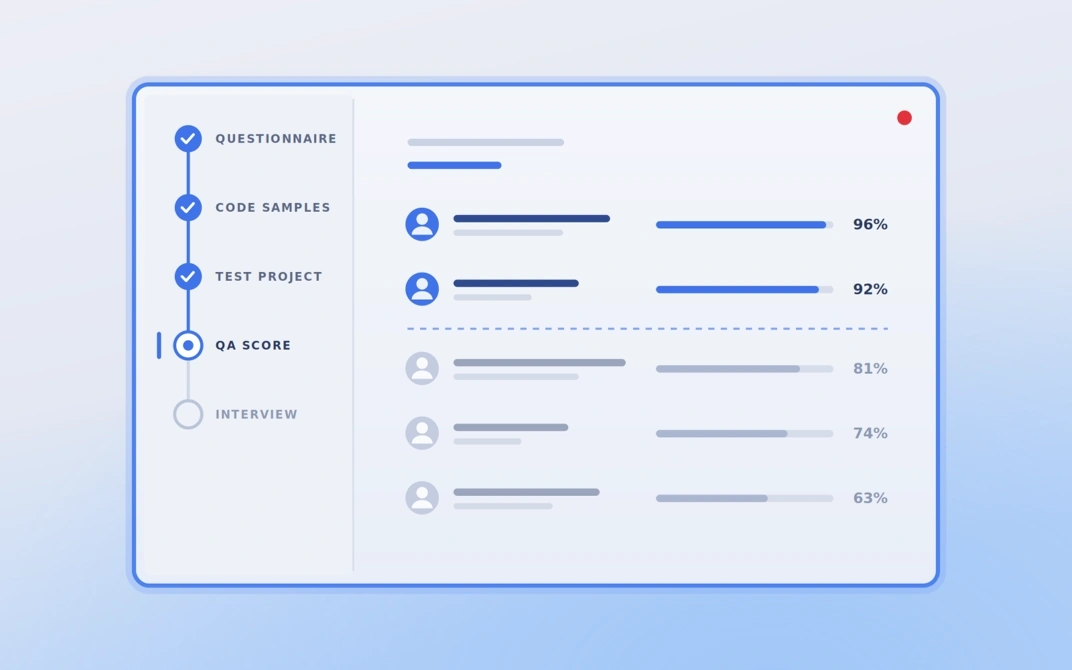
Of course, evaluating test projects takes some time, so it's good to do the first sorting with a quick review of code samples provided by candidates. An effective hiring process could then look like this:
- Send a questionnaire to candidates to collect basic information about them, including their code samples.
- Review the code samples to identify candidates to send the test project to.
- Send the test project to the selected candidates.
- Evaluate the test projects according to the QA Checklist and calculate their QA Scores.
- Invite the candidates with the best scores for an interview.
This way, we integrate part of our onboarding process into the hiring process. This makes onboarding more effective, and the candidate joins the company already familiar with our development processes, standards, and expectations regarding their work.
Further, we recommend a training period covering the first couple of projects, where Advanced QA is done and detailed feedback is provided on the new front-end developer's work, so they can reach a high quality standard as soon as possible.
Series Contents
- Code Quality Assurance Checklist: 8/20 Rule
- Can Front-End Code Quality Be Measured?
- Using QA in Front-End Developer Recruitment
About the author